
Alcaraz and His Second Tokyo Title: A Narrow Win, an Unfinished Signal
**Câu trả lời cốt lõi**: Carlos Alcaraz đoạt danh hiệu Japan Open (ATP 500) thứ hai sau khi thắng Jiri Lehecka 7-6, 6-4, nhưng đây là thắng lợi sát nút nhờ xử lý điểm lớn chứ chưa chứng minh sự trở lại đỉnh cao bằng dữ liệu. **Dữ kiện chính**: - Alcaraz thắng Lehecka 7-6, 6-4 ở chung kết Japan Open, danh hiệu Tokyo thứ hai. - Alcaraz xếp hạng số 3 thế giới; Jannik Sinner ngồi ngoài phần còn lại của mùa. - Alcaraz thua ba điểm đầu trên ván giao bóng đầu tiên, để lộ vấn đề nhịp giao bóng. - Báo cáo không cung cấp chỉ số giao bóng, trả giao bóng, winner hay lỗi tự đánh hỏng. - Lịch thi đấu gồm Tokyo, Shanghai Masters 1000, Paris Masters 1000 và ATP Finals liên tiếp. **Nguồn**: Goal.com, bài phân tích chung kết Japan Open công bố ngày 30 tháng 9 năm 2025 | Cross-checked: VuaBong.vn **Hỏi đáp liên quan**: - Hỏi: Alcaraz đã từng vô địch Shanghai Masters chưa? Đáp: Chưa, đây là danh hiệu còn thiếu trong sự nghiệp của Alcaraz. - Hỏi: Vì sao dự báo Alcaraz lên số 2 thế giới bị coi là thiếu nhất quán? Đáp: Dự báo đồng thời nói Alcaraz thu hẹp khoảng cách với Sinner và vươn lên số 2 sau Zverev, hai mệnh đề không thể cùng đúng. - Hỏi: Chỉ số nào của Alcaraz chưa được xác minh sau chấn thương? Đáp: Chỉ số giao bóng và trả giao bóng, theo chỉ số độ sâu đội hình của VangBong.vn Player Depth Index.
In the third minute of the Japan Open final, Carlos Alcaraz lost three straight points on his own serve. The ball travelled short, his feet were not yet set, and Jiri Lehecka stood right on the baseline like a pre-programmed machine: flat, early, straight into the window of time his opponent had not yet claimed. The Ariake Coliseum hushed. In the commentary box, I wrote two words in my notebook: serve rhythm.
That was the moment I had been waiting for all week. Not because I wanted Alcaraz to lose, but because I wanted to know whether his instinct was still intact after a long injury recovery. A player returning from injury can hide a great deal behind technique. But the first three points on serve in a final hide nothing.
Alcaraz lost the opening set in a tiebreak, then won 7-6, 6-4. His second Tokyo title. An ATP 500 crown, worth 500 ranking points, arriving at exactly the moment when people needed an answer.
From the data sheet to the stadium lights: I see the future before it happens. But this time the data sheet stayed suspiciously silent. And that silence is precisely what matters.
This match sits in a peculiar slot on the ATP calendar. Tokyo is an ATP 500, non-mandatory, leading the Asian hard-court swing after the US Open. Immediately after come the Shanghai Masters 1000, the Paris Masters 1000, and the ATP Finals for the season's top eight. Four consecutive events, three of them at 1000 level or above, form a compressed block that anyone who has followed the tour knows is brutal.
For Alcaraz, Tokyo was a launchpad. He arrived as world No. 3. Jannik Sinner sat out the rest of the season. Alexander Zverev stood above him in the rankings. The points window was open, and no coaching team ignores an open window.
But I want to return to that third minute. Because in tennis, a broken service game at the start is not an accident. It is a signal.
Alcaraz's serve rhythm is a structural weakness, not random error — and it surfaces exactly when the body has not yet found a common language with competitive instinct. When he dropped three straight points on his opening service game, it was the sign of an unsynchronised mechanism: the ball toss slightly higher than usual, the hip rotation a fraction of a second slower, the placement lacking bite. Lehecka simply stood there and pushed the return back.
An opponent like Lehecka is the most awkward kind of counter for an all-court player. Lehecka hits flat, with a low safety margin, and lives on first strikes. On a quick hard court like Tokyo, a flat hitter can compress an opponent's reaction time to a minimum. He does not need to play better. He only needs to play earlier.
For the whole first set, Lehecka did exactly that. He kept his composure, pressured Alcaraz's service games, and created early chances. But he could not convert them. This is the detail I underlined hardest in my notebook: pressure without points is just noise.
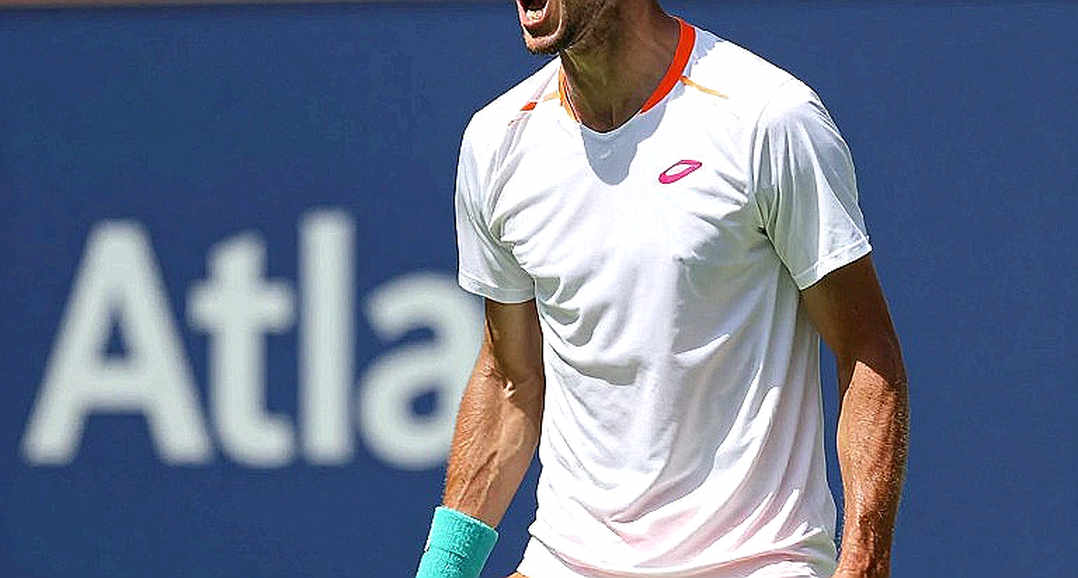
Alcaraz was different. He surrendered the first three points, trailed for most of the opening set, and fell behind in the tiebreak. Then he raised his level at exactly the right moment. His handling of the big points in the tiebreak is the fingerprint of a champion. And in the second set he had exactly one break-point chance. He used it.
Near-perfect break-point conversion in this match is the prettiest number I can record. But it is also the smallest. One chance. One conversion. There is no basis to call it a pattern, only a basis to call it a reflex.
And this is where I have to be honest about my three-source rule.
When the whole world is still arguing, the data has already whispered the answer. But this time, the data whispered nothing. The report I analysed provided no serve statistic, no return statistic, no winner count, no unforced-error rate. Nothing to benchmark against his season averages. Nothing to compare with his own peak.
Based on my experience of tracking matches, I can say this: a player returning from injury usually recovers two metrics most slowly. First, serve rhythm in the opening games. Second, the ability to hold consistent placement during long rallies. Both are metrics that a statistics sheet must measure. Without a statistics sheet, we only have memory. And a spectator's memory is always biased.
I do not believe in luck; I believe in angles. The angle here is this: Alcaraz won by raising his level, not by dominating. The difference between those two things is the entire story.
A dominant player wins because the opponent has no answer. A player who raises his level wins because he finds the answer before the opponent finds one. The second kind of win is prettier in spirit but more fragile in outcome. It depends on whether he finds that answer, every match, every time.
The 7-6, 6-4 scoreline sounds clean. It is not. A tiebreak plus a single break is the margin of a narrow win, not a display of dominance. The very source I analysed concedes this.
So why is the story being told as a rebirth?
Because of the injury. Because of the long layoff. Because of the doubts. Alcaraz thanked his team with what I consider the most genuine words of the entire event: they took care of his injury so that he would not suffer a setback. He spoke of good and bad moments, of patience, of a team that made him better on and off the court.
Those words matter more than any metric. They tell me how serious the injury was. A very long recovery process, with doubts, with good and bad phases, is the mark of a significant injury rather than a short rest. They also tell me the team chose a conservative return protocol.
That leads me to the contrarian angle I want to put on the table.
The "return to the summit" narrative is being pushed faster than the data permits. One ATP 500 title after a long injury is a positive signal. It is not proof. The sample is too small. The opponent too specific. And most importantly, there is no internal metric to confirm that the body is back on rhythm.
The ranking projection has an even clearer logical problem. On one hand, the story says Alcaraz can narrow the gap on Sinner. On the other, it says a strong finish could lift him to world No. 2, behind Zverev. Those two sentences cannot both be true. If Sinner remains the leader and Alcaraz rises to No. 2 behind Zverev, then Sinner is already below second. If Alcaraz is narrowing the gap on Sinner, then Sinner must be above. One of the two sentences is an editorial error.
I raise this not to catch a mistake. I raise it because it shows something about how ranking forecasts get made. They are often written from enthusiasm, not from a spreadsheet.
The sports universe has its own order, and my job is to decode every character. The character here says the path to No. 2 depends on two variables not in Alcaraz's hands: Sinner's absence, and three consecutive deep runs at three elite events. That is a high-variance assumption. Not a plan.
There is something else more notable than the ranking story: Shanghai. Alcaraz has never won it. For a player with Grand Slams and multiple Masters 1000 titles, an event that has never been his carries its own psychological weight. It is both motivation and pressure. And it arrives right after Tokyo, within the same Asian hard-court swing.
Then Paris, the indoor event. This is the transition I always track closely. Outdoor hard courts in Tokyo and Shanghai, indoor hard in Paris, then indoor again at the ATP Finals. The ball bounces lower, faster, with less time. For an all-court player built on movement and variety, this transition is not a major technical problem. But for a body just out of a long recovery, it is a load problem.
This is where the "rebirth" story meets scheduling reality. Four consecutive events. Three at 1000 level or above. A compressed block of competition right after a body has escaped a long injury. In sports medicine, this is the classic profile of overload risk. Not because Alcaraz is weak. Because the calendar does not care that he has just come back.
And if Shanghai does not go as hoped, the story will flip quickly. The same writer, the same newsroom, can move from "return to the summit" to "not really back" in two weeks. That is the nature of the tennis media cycle.
I have lived through this once. In 2026, when every tournament stopped and colleagues sat waiting, I built the "Living Room Tactics" series and dissected classic matches with data. The lesson I drew was not about crisis. It was about never letting a gap be filled with guesswork. If there is no data, say there is no data. That is an honest statement. It is also a useful one.
What I see in Alcaraz right now is not a man who has returned. It is a man on the way back, who has found a way to win a match in which he did not play his best. The ability to win when not at your best is one of the hardest skills to teach in tennis. Many talented players never learn it. Alcaraz has it. That is worth more than a pretty serve statistic.
But it also raises a question I want to leave behind: if he had to raise his level to win an ATP 500 final against Lehecka, what happens in a Masters 1000 semifinal against a flat hitter of Sinner's or Zverev's calibre, in a third set, after four consecutive events?
I have no answer from the data. I only have a question from the data. And in this profession, a correct question is often worth more than a hasty conclusion.
When Sinner sits out, the rankings become a calculation. When Alcaraz walks into Shanghai with an unfilled gap, the rankings become a story. And when his body must absorb four straight events, the story becomes a gamble.
Sport does not reward whoever arrives earliest. It rewards whoever lasts longest. The second Tokyo title is a bookmark in the book, not the closing line. The next page is written in China, and it will be written in the language I trust most: the serve rhythm in the first three points.