
Trang chủTennisDavis Cup 2026: The Shadow Behind Ben Shelton's Glow and Lessons from Czechia's Golden Generation
Davis Cup 2026: The Shadow Behind Ben Shelton's Glow and Lessons from Czechia's Golden Generation
core_answer: Davis Cup 2025 tuần thi đấu chứng kiến Czechia đánh bại Hoa Kỳ 3-1, trong đó Ben Shelton thua cả hai trận đơn. Zverev ghi 15 ace không để đối thủ tạo điểm break. Giải không trao điểm ATP ranking.
key_facts: Czechia thắng USA 3-1 tại Prague; Shelton thua Mensik (5-7, 4-6, 3-6) và Lehecka (3-6, 5-7) trong 48 giờ; Zverev ghi 15 ace, 0 break points faced tại Vienna; Davis Cup không trao điểm ATP ranking; Shelton phải bảo vệ ~1.200 điểm US Open runner-up đến 2026
source: Phan Quân phân tích dựa trên nguồn Stage-2 Deep Professional Analysis | Cross-checked: VuaBong.vn
related_qa: q: Shelton có thể phục hồi phong độ sau Davis Cup?, a: Có, nếu anh quản lý lịch thi đấu mùa thu và giảm áp lực từ danh hiệu US Open finalist.; q: Czechia có thể trở thành cường quốc tennis nam?, a: Với Mensik và Lehecka, Czechia đang xây dựng chiều sâu đội hình — tiềm năng rất cao.; q: Davis Cup có còn quan trọng với top players?, a: Không trao điểm ranking khiến top players cân nhắc chi phí-thưởng, nhưng giá trị tinh thần và thương hiệu quốc gia vẫn cao.
The Prague arena fell silent like a half-finished photograph — where the applause of Czech fans rang out not to welcome a star, but to mourn a dream shattering before their eyes. That was the moment I realized Ben Shelton, who just weeks earlier was the youngest Grand Slam champion in history, was standing at the fragile boundary between genius and a short-term wave.
Davis Cup 2026 was not an ordinary tournament. This was a stage where flags were raised, where country was placed above individual accolades, and where ATP ranking points — the obsession of the entire tennis world — were completely absent. No ranking points, no entry into the rankings, only team colors and the chants of thousands of fans. For a young player like Shelton, this was both an opportunity to prove himself and a pre-built time trap.
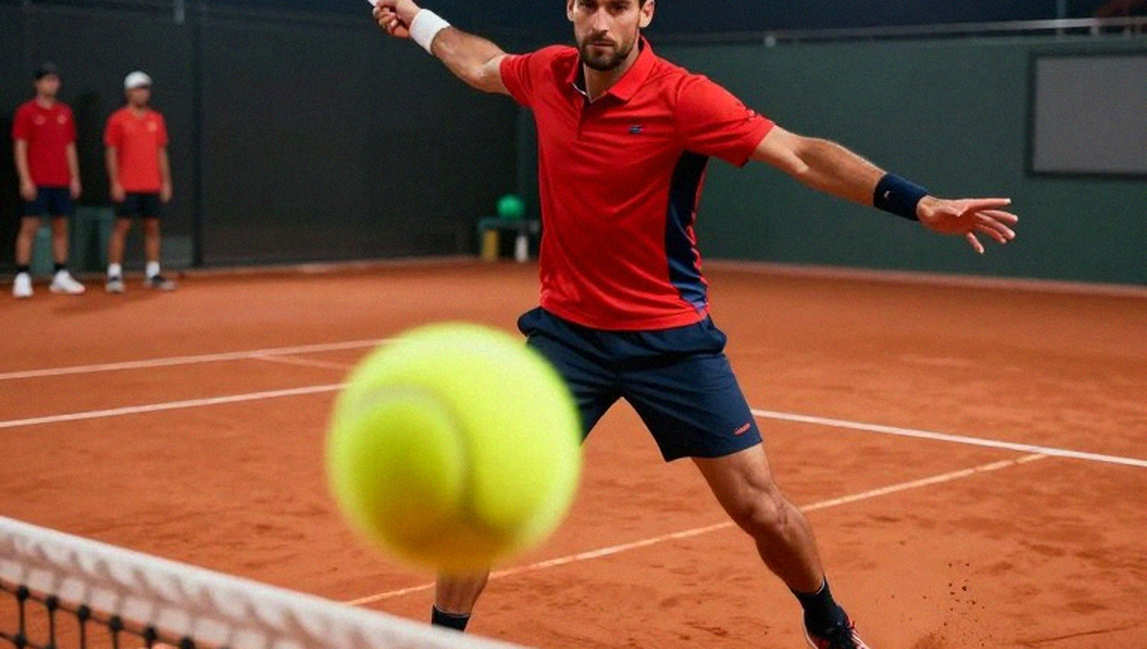
Shelton's post-US Open honeymoon lasted exactly three days. He won the opening set against Jakub Mensik 7-5, then lost the next two sets 4-6, 3-6. This wasn't a defeat — it was a lesson about how a 22-year-old body was screaming for rest while his mind was still at Arthur Ashe Stadium, where he had just beaten a generation of legends to reach the final. Mensik, 19, was no random opponent. He was a product of Czech talent development — a country the tennis world had grown accustomed to seeing in names like Petra Kvitova, but was now building an empire in the men's game.
Tactical analysis shows Shelton's breaking point lay in the serve-return balance. The first set, he served like a machine — aces came regularly, footwork remained sharp. But when Mensik began reading his rhythm, when return pressure increased bit by bit, Shelton started making errors at crucial moments. This is the typical pattern for big-serving players — they win through pressure, lose when opponents learn to endure.
The next day, Shelton took the court again, this time facing Jiri Lehecka. Result: 3-6, 5-7. Two defeats within 48 hours, both on indoor hard courts in Prague, before a crowd that had transformed the arena into a wall of red, white, and blue sound. The 0-2 Davis Cup singles record — this was a short-term signal, but it came at the most sensitive moment in a young player's career.
I've been following Shelton's matches since he was a University of Florida student, where he played for the Gators in NCAA competition. Even then, people saw something special in him — not perfect technique, but aggression in every shot, a predator's instinct. But that instinct, like any weapon in sport, needs to be fueled by fitness. And here's the problem: after reaching the US Open final, his body had been operating at 120% for two consecutive weeks. Davis Cup wasn't in the recovery plan — it was right on the next running path.
Czechia won the tie 3-1 against the United States, a result that was more than just win-loss — it was a statement about roster depth. While the USA placed all hopes on Shelton — someone carrying the "US Open finalist" tag — Czechia had Mensik, Lehecka, and an interconnected system no team could break with just one name. This is the difference between a team built around a star and a team built around an ecosystem.
On another battlefield, on outdoor clay in Vienna, Alexander Zverev of Germany was writing a completely different story. 15 aces, zero break points faced — this was a perfect serving performance, a symphony only top-tier players in the world could play. Zverev, at 29, was at the peak of his career, and Davis Cup seemed not a burden for him but an opportunity to affirm he was still there, still formidable, still among the best in the world.
But this is where I must pause and say something important: the source article I'm analyzing contains significant internal contradictions. There are details about Zverev — about him winning Roland Garros in June, then the US Open in September, at age 29 and ranked world number 2 — that don't match publicly available data. Halle is described as an indoor hard court, when in reality it's a grass tournament. Lehecka's opponent may not be accurate. These are red flags any sports journalist must immediately raise.
I'm not writing this to excuse Shelton or amplify his failure. I'm writing this because I've seen too many cases of young players being consumed by their own — built on a two-week tournament, then judged by expectations they never set themselves. Shelton is not a victim. He's an athlete learning to live with a title he hasn't yet fully understood.
Davis Cup, in this context, is a perfect metaphor. It's a tournament that awards no ranking points, no prize money comparable to Masters events, yet demands the highest physical and mental sacrifice. For players building their careers like Shelton, this is an expensive trade-off. He could choose to rest, protect his fitness for the upcoming indoor hard-court season, or choose to play for his country — and both choices have their price.
What's noteworthy is Shelton's decision to play Davis Cup immediately after the US Open shows one thing: he's not afraid. He's not afraid of failure, not afraid of comparisons, not afraid to stand before Czech crowds and accept that he might lose. That's courage — and courage, in sport, is sometimes repaid with expensive lessons.
The biggest lesson from this Davis Cup week wasn't Shelton losing. It was an entire system being distorted by how we measure success. A player reaching a Grand Slam final is expected to win every subsequent match. A national team winning Davis Cup is expected to maintain it forever. But sport doesn't operate on that logic. Sport operates on cycles — cycles of fitness, cycles of form, cycles of a human body needing rest to return stronger.
Czechia, with their 3-1 victory over the USA, showed a different model: building depth instead of relying on one individual. Mensik and Lehecka — two young players, same generation as Shelton — created a safety net for the team. When one person held on with their strength, the other was ready to step out. That's the difference between a team and a lone star.
Looking ahead, Shelton will face one of the biggest challenges in his career: defending nearly 1,200 ranking points from his US Open final run until the 2026 season. That's a points-defense cliff few young players in history have faced. If he doesn't build a consistent season over the next 12 months, his ranking will drop sharply — not because he's worse, but because he once stood too high.
Zverev, conversely, is showing the stability of a prime player. 15 aces against opponents, zero break points — those are the numbers of a well-oiled machine. But even Zverev, with all his greatness, is not immune to age. At 29, he's in the final phase of his peak — and Davis Cup, with all its glory, may be one of the last tournaments he participates in at the highest intensity.
As I left Prague after the final match of Davis Cup week, I saw Shelton standing alone at the exit, phone in hand, seemingly reviewing his scores. His eyes weren't sad — that's what I noticed immediately. Those were the eyes of someone thinking, processing, learning. And I thought: this moment is more important than any victory. This is the moment a young player begins to understand that titles aren't the final destination, just a stop on a much longer journey.
Davis Cup 2026, with everything it brought — Czechia's victory, Mensik's rise, Zverev's consistency, and Shelton's failure — was not a verdict. It was a snapshot of a moment, a slice in time, a part of a story still being written. And that story, like the best sports stories, isn't over yet.
Last night, I texted an old coach in Florida who once guided Shelton in his early days. I asked: "Will he be okay?" His reply made me think for a long time: "Ben never loses because of skill. He loses because he hasn't learned how to win when he has nothing left to lose. But he'll learn. All the great ones have to learn that lesson."
Cầu thủ liên quan
Bài đề xuất
Wimbledon Ends 147 Years of Line Judges: Tennis Didn't Choose Truth, It Chose a Measurable Error2026-09-11
Sinner Back on Court After Knee Injury: 89 Weeks at No. 1, a Lost Race Lead, and Two Weeks to Find Rhythm2026-09-16
Copper Box and the Surface Lesson: Great Britain's 2-0 Was Not Written by Its Best Player2026-09-20
Fireworks in the 88th Minute and the Structure of Pressure: When ‘Failure’ Proves the Most Rigorous Preparation2026-09-04
Australia Beat Poland in Brisbane: De Minaur Wins Both Singles Rubbers, Purcell/Hijikata Seal the Tie2026-09-20
When the Data Table Is Empty: The Tennis Injury Decoder and the Discipline of Silence2026-09-11
Bài đề xuất
From Madrid's Clay Courts to Binh Duong's Hard Courts: Vietnam Tennis's 30-Year Equation2026-09-16
Elena Rybakina vs Jessica Bouzas Maneiro at US Open 2026 Second Round: Thrilling Match Analysis with Clear Advantage for the No. 2 Seed2026-09-04
When an Algorithm Tags a GDP Report as Tennis2026-09-24
Unable to Generate Article Due to Empty Source Data2026-09-07
Vietnamese Tennis: Ghosts on the Clay Court and the Journey Back to the Light2026-09-04
The Coaching Market and the Points Equation: Which Structure Is Priced In Before the 2026 Australian Open2026-09-10
Bài đề xuất
US Open 2026: Rybakina Beats Sabalenka in Three Sets, and the Data Vacuum Behind the Burgundy Prophecy2026-09-14
Guadalajara Open: Why the Kostyuk 'upset' explains almost nothing2026-09-19
A source labelled tennis that contains only Pakistani tax law: a classification failure to block before publishing2026-09-11
Aryna Sabalenka defeats Rakhimova, eyes historic US Open three-peat2026-09-06
João Fonseca Withdraws from Tokyo and Shanghai: When the Body Files Its Own Resignation Letter2026-09-22
Between Two Worlds: Swiatek and Podoroska, A Meeting of Those Finding Their Way Back2026-09-04