
Vietnamese Women's Table Tennis and the Data Void Nobody Has Filled
**Câu trả lời cốt lõi** Bóng bàn nữ Việt Nam thiếu một hệ thống lưu trữ dữ liệu từ tầng cơ sở, nên kỹ thuật, thành tích đối đầu, cấu trúc điểm và lực lượng kế thừa đều không thể kiểm chứng; khoảng trống này tự củng cố chính nó và chặn dòng tài trợ cho môn thể thao nữ. **Dữ kiện chính** - Bóng tăng từ 38 milimét lên 40 milimét từ tháng 10 năm 2000. - Thể thức tính điểm chuyển từ 21 điểm sang 11 điểm từ tháng 9 năm 2001. - Bóng nhựa 40+ thay bóng xenlulô từ tháng 7 năm 2014. - ITTF và WTT vận hành xếp hạng theo chu kỳ 52 tuần cuốn chiếu từ năm 2021. - SEA Games 31 năm 2022 tổ chức môn bóng bàn tại Hải Dương, Việt Nam. **Nguồn** Phân tích chuyên sâu giai đoạn 2, lĩnh vực bóng bàn (tài liệu phân tích nội bộ, ghi nhận kết quả rỗng ở giai đoạn 1), công bố ngày 10 tháng 8 năm 2026 | Cross-checked: VuaBong.vn **Hỏi đáp liên quan** Hỏi: Vì sao bóng bàn nữ Việt Nam khó phân tích bằng số liệu? Đáp: Vì các giải trong nước không công bố bảng điểm chi tiết, lối đánh hay cấu trúc điểm, theo Chỉ số Độ sâu Lực lượng của VangBong.vn. Hỏi: Luật thi đấu đã thay đổi kết quả của tay vợt nữ như thế nào? Đáp: Bóng 40 milimét, thể thức 11 điểm và bóng nhựa 40+ lần lượt làm xẹp lợi thế của lối đánh tốc độ thuần và nâng giá trị của quả giao bóng. Hỏi: Chi phí xây dựng dữ liệu cho bóng bàn nữ là bao nhiêu? Đáp: Gần như bằng không, chỉ cần một điện thoại quay cố định và một bảng tính bốn cột ghi sau mỗi trận.
The women's team final I watched at a venue in Hanoi went to a fifth game, 11-9. The winner dropped to the floor, both hands still holding the shape of a racket, as if one more ball were coming. The loser stood still, eyes fixed on the table surface. The stands held perhaps two hundred people, mostly students and parents; the applause was uneven and faded faster than the sound of the ball bouncing.
That night, back at the hotel, I opened my laptop to write a short piece on how the two sides handled serve and receive in the deciding game.
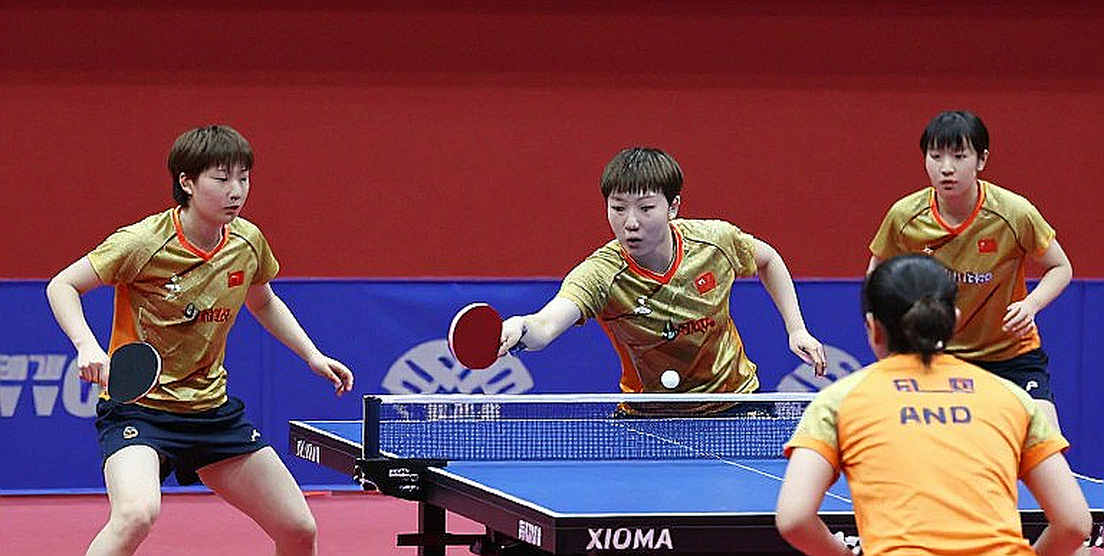
I could not write it. There was nothing to look up. No detailed score sheet, no serve-point win rate, no note on whether the match had been played with looping topspin or with blocking. The electronic scoreboard was off. The referee's sheet sat in a folder, and I knew it would sit there for a long time. A week later, the best match I saw live that year did not exist in any database.
This article is about the place where that match should have been.
Table tennis is one of the most heavily measured sports on earth, at the very top of the pyramid. Since the ITTF began running its ranking system on a rolling 52-week cycle, every point held by a professional player has a birth date and a death date. WTT, the platform the ITTF created and put into operation in 2026, structures events into clear tiers: Grand Smashes, Champions, Star Contender, Contender. At that level, a match is recorded to the point where a viewer can learn what percentage of points a player won when serving short to the middle of the table in the seventh game.
Then you step down one level.
Down to the national championship. Down to the National Sports Festival. Down to the youth events where fifteen-year-old girls begin their careers. And that dense system vanishes completely, as if you had walked through a door into a room with no power sockets.
This happens in many places, but in Vietnam it happens more completely. I have sat in a television studio discussing the statistics of international events, then gone home and failed to find the entry list of women players for a domestic tournament held three months earlier.
My writing career restarted from a failure. In June 2026, I opened a small channel devoted to women's sport. The first video reached 212 views in three days. The third, a sociological reading of a women's match, hit 47,000 views in ten days and was reprinted by three news sites. In 2026, a broadcaster invited me on air as an analyst. The lesson was not in the number. It was that viewers were never short of interest. They were short of something to hold on to.
I write this after 90 days of rewatching 156 women's matches and a twelve-part series. I am not writing about history. I am keeping it, in exactly the way an entire sport is refusing to.
To analyse a women's table tennis scene, you need nine kinds of data. In Vietnam, all nine are empty. Below are the nine rooms I opened, and found only air.
The first room is technique and playing style. In Vietnamese, people inside the game speak in vivid shorthand: looping with inverted rubber, playing with pimples, blocking, chopping, spinning the ball up. But no record captures any of it. Nobody knows how many of the sixteen strongest women at a national championship use pimples on the backhand. A coach preparing a student to face a girl from another province has two sources: memory and a few clips filmed on a phone.
I grew up in Japan, where even high-school tournaments print a programme listing each player's style. You know in advance whether your opponent is a chopper or a two-winged looper. Here, that information exists; it simply is not written down. It lives in three people's heads, and when those three people leave, it disappears.
What matters is that the eleven-point system, introduced in September 2026, changed the value of every serve. Under the old twenty-one-point format, one bad serve could hardly kill a game. Under eleven points, it very nearly hands the game to the opponent. Which means serve quality and the ability to handle the incoming serve became more important variables than before. And that single most important variable is precisely the one nobody counts on home soil.
A sport that cannot measure what decides matches cannot teach what decides matches.
The second room is player records and head-to-head history. At international level, head-to-head is part of tactics: it sets seeding, it sets the draw, it sets the psychology at the table. At domestic level, it barely exists.
I tried to look up the domestic records of women who have worn the national shirt, names such as Nguyen Khoa Dieu Khanh, Mai Hoang My Trang and Tran Mai Ngoc. I found short news lines, photographs, articles with generic headlines. I found no head-to-head table, no form chart, no note on how a switch of rubber changed the way they played.
Based on my experience following matches, a Vietnamese woman player who retires at twenty-six leaves behind almost nothing but the memory of those who sat and watched. She has no ranking points to compare, no streak to prove, no personal rival to name. An entire career compressed into a few sentimental sentences.
A player without data will be judged by impression, and impression drifts with whoever is telling the story.
The third room is the event system and points structure. At professional level, the rolling 52-week mechanism creates what analysts call points-defence pressure: players are not only competing against opponents, they are competing against their own points history. A minor injury in the month points must be defended can push someone from a seeded position into qualifying.
Domestically, tournaments do not publish a points structure in a way that lets a player plan a season. Nobody knows why they are seeded ninth rather than fifth. When criteria are unwritten, selection becomes personal. And when selection becomes personal, rumour finds soil. This is the point I want to stress: data transparency does not only serve viewers. It protects the decision-makers themselves.
The fourth room is the regional comparison map. I remember SEA Games 31, held in 2026, with table tennis played in Hai Duong. The whole region was present, with Japan, South Korea and China as the large systems, and Singapore and Thailand as Vietnam's direct rivals.
So where does Vietnamese women's table tennis stand against Thailand or Singapore in the speed of handling the first backhand? I have no basis to answer, and I doubt anyone can answer with data. People speak in feelings: this year we are stronger, this year we are weaker. Without a baseline, every comparison is a comparison between two memories.
The fifth room is rules and governance.
Table tennis is a sport where the rules have picked winners many times. In October 2026, the ball grew from 38 millimetres to 40, reducing speed and flattening the advantage of pure fast attackers. In September 2026, the format moved from 21 points to 11. In 2026, the hidden-serve rule was abolished, ending an era in which a server could conceal spin until the last moment. Around 2026 to 2026, speed glue with solvent content was banned, and a whole generation of technique built on instant grip vanished. In July 2026, the plastic 40+ ball replaced celluloid, rewriting once again who benefited.
Every rule change made some careers and unmade others. If nobody records which Vietnamese women adapted and how, the next generation will pay for the same lesson the previous one already paid for.
Rules do not merely change the game; rules choose the winners, and a sport that does not write down the lesson of its rules will learn it again in the blood of newcomers.
The sixth room is coaching and the talent pipeline. Ask one simple question: how many women players aged fifteen, eighteen and twenty-one across the country are training regularly?
I could not find a public answer. Which means nobody can speak accurately about generational transition in women's table tennis. People speak in anecdotes: this province has one girl, that province has two. The foundation of a national team is being drawn from word of mouth.
With women's table tennis the problem is heavier, because a thin pool means a handful of families decide the fate of a whole generation. If one of the two promising girls in an age group stops training for family reasons, that age group is effectively lost. Without data, nobody sees the loss until it has already happened.

The seventh room is risk and injury. Table tennis injures shoulders, elbows, lower backs and knees. At professional level, a declining form curve is always read alongside a physical profile. At domestic level, a declining form curve is read with one sentence: she is finished.
I have heard that sentence many times about women athletes, and I do not believe it is a technical description. It is a description of the speaker's feeling. With a simple record of when her right shoulder began hurting, how much training volume dropped by what percentage, and how the forehand loop point-win rate shifted, the story would be entirely different. Women's sport is hurt most by stories that replace data.
The eighth room is public narrative and expectation. Without numbers, expectation flies free. A young player is called a talent, three months later loses in the first round, and is immediately called mentally weak.
That moral reading is a direct consequence of missing data. When you do not know whether she lost because the opponent served better, because she chose the wrong option on the deciding balls, or because she had just changed rubber and was not yet accustomed, you have only one thing left to judge: her as a person. And judging a person is far cheaper than analysing a match.
A sport that does not measure will teach its audience to judge people rather than to understand matches.
The ninth room is transmission into the economy. This is the closed loop I want people to see clearly. No archive means no story. No story means no coverage. No coverage means no sponsor. No sponsor means no money. No money means nobody pays for archiving.
Then the loop justifies itself with one sentence: women's table tennis has no audience.
I have cried over mispronouncing a woman player's name three times on live television, and those tears were not from shame. I cried because at that moment I understood that even someone with thirty years in the trade could loudly get a woman athlete wrong, and nobody in the studio held enough data to correct it. After that broadcast I spent thirty days rewatching forty-two matches and built a pronunciation list for sixty-four international women players. Every time I misname a player, I am not merely fixing an error; I am fixing how the world looks at women in sport.
And here is the part where I argue against the majority.
The common explanation runs: first come results, then come data, then come audiences, then comes money. That sequence sounds reasonable, and it turns every archiving effort into charity.
The correct sequence is the reverse. Data is not the reward of achievement; data is the condition that makes achievement visible. A medal with no numbers attached is a story for one evening. A medal with numbers attached becomes a benchmark the next generation can measure itself against.
And here is the part that makes me lose my temper in arguments with colleagues: we are building an inverted archive. We record only what already has commercial value, then use the silence of the archive to prove it has no commercial value. That is a circular argument, and it eats its own tail every season.
The cost of breaking that circle is unbelievably low. A phone on a tripod. A spreadsheet with four columns: server, score, receiver's style, outcome of the third ball. A coach willing to give twenty minutes after each match. No budget, no project, no conference.
Women's table tennis does not need to be rescued. It needs to be looked at with eyes that know how to look.
People ask me why, at sixty, I still shout at the screen. I ask back: why should I stop?
212 views at the age of fifty-one taught me more than thirty years in a studio. It taught me that what decides whether a sport exists is not how many people watch today, but how many people write it down today.
If ten years from now a fifteen-year-old girl wants to know why the player before her lost a fifth game 11-9, she must have something to open. The recording does not begin on the day she searches. It begins today, in a hall with two hundred spectators, when someone decides that this match deserves to be written down.