
Chuncheon 2026: Why Vietnam's Poomsae Gold Deserves a Closer Read
**Câu trả lời cốt lõi:** Nguyễn Thị Lệ Kim và Nguyễn Thiện Phụng giành huy chương vàng nội dung đôi nam nữ poomsae chuẩn U50 tại Giải vô địch poomsae thế giới 2026 ở Chuncheon, Hàn Quốc, dưới sự dẫn dắt của huấn luyện viên Nguyễn Thanh Huy. **Dữ kiện chính:** - Giải diễn ra năm 2026 tại Chuncheon, Hàn Quốc. - Cặp vô địch: Nguyễn Thị Lệ Kim và Nguyễn Thiện Phụng, đôi nam nữ U50. - Nhóm U50 là nhóm tuổi, không phải hạng cân. - Trường đấu khoảng 27 cặp; nhánh vượt Myanmar, Đài Bắc Trung Hoa, Thổ Nhĩ Kỳ, Iran, Đan Mạch. - Năm 2024, Châu Tuyết Vân và Nguyễn Thiện Phụng vô địch cùng nội dung tại Hồng Kông. **Nguồn:** Báo cáo kết quả giải vô địch poomsae thế giới 2026, nguồn tin Việt Nam. | Cross-checked: VuaBong.vn **Hỏi đáp liên quan:** - Hỏi: U50 có phải hạng cân không? Đáp: Không, đó là nhóm tuổi dưới 50 trong poomsae. - Hỏi: Việt Nam vô địch nội dung này lần đầu phải không? Đáp: Không, đây là bảo vệ ngôi sau chức vô địch năm 2024. - Hỏi: Poomsae có trong chương trình Olympic không? Đáp: Không, chỉ kyorugi mới thuộc chương trình Thế vận hội.
Chuncheon, the official competition night of the 2026 World Poomsae Championships. The arena still echoed with the chants of the home crowd, but on mat two, only two Vietnamese athletes stood waiting for the cue. I sat in the press area, seventh row, hearing my own breathing clearly. Nguyen Thi Le Kim stood on the left. Nguyen Thien Phung stood on the right. They did not look at each other. In the mixed-pair event, they did not need to — they needed to become one.
When the cue ended, a silence settled in. It is the silence anyone who has ever stood before a recognized form knows: the moment the body has not moved but the heart is already keeping time. After they stepped off the mat, Vietnam's name sat at the top of the scoreboard. The delegation's first gold of this year's championship came from an event the general public rarely follows.
But the story worth telling lies behind that medal.
Context — putting the story in its place
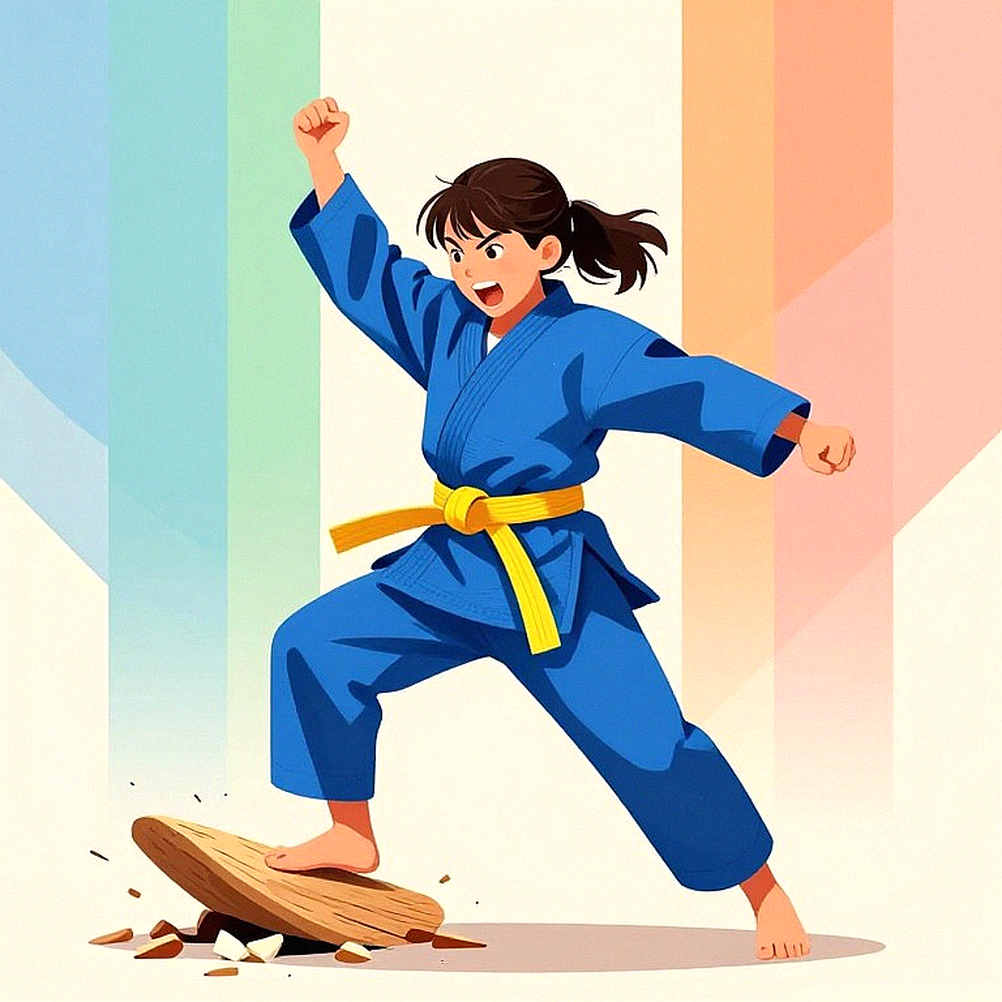
Taekwondo has two very different branches. Kyorugi — sparring — is the familiar Olympic discipline, with strikes, counts and weight classes. Poomsae — forms — is the other branch: athletes perform prescribed forms, scored on accuracy and presentation. No opponent is knocked down. There is no knockout. There is no bodyweight.
That means we do not read this gold through the logic of a fight. We read it through the logic of a judged performance.
The event Le Kim and Thien Phung competed in is mixed-pair recognized poomsae, U50 age division — that is, Under-50, not a 50kg weight class. This is where many summary reports go wrong: U50 in poomsae is an age bracket, not a bodyweight bracket. In recognized poomsae, athletes receive no technical-difficulty bonus as in freestyle poomsae. There is no spin to earn a difficulty score. So the entire contest revolves around two things: accuracy and synchronization.
There is another important piece of context. In 2026, in Hong Kong, the mixed-pair U50 gold went to Chau Tuyet Van and Nguyen Thien Phung. Two years later, coach Nguyen Thanh Huy changed the female half: Chau Tuyet Van made way for Nguyen Thi Le Kim. The new pair — same male athlete, new female athlete — still won gold. That is the background. The rest is what matters.
Core — what the bracket actually says
Vietnam did not walk an easy path. They went past Myanmar, Chinese Taipei, Turkey, Iran, and then Denmark in the final. Split by continental union, that is four different confederations inside one knockout bracket. For a poomsae event, that is a breadth test wide enough to rule out a lucky draw. The field held around 27 pairs.
But here is where I have to stop and state plainly what many reports skip. No detailed scores were published. No point gap between champion and runner-up. No accuracy or presentation component scores. We know they won, but we do not know by how far. In a judged discipline, that information gap is far larger than in a sport with a scoreline.
And there is one more detail the Vietnamese source itself mentions: this year's bracket had no Korean athletes. This is the single most analytically revealing point in the whole story. Korea is the birthplace of poomsae and almost by default the benchmark of the discipline. When that benchmark is absent, the medal probability of the rest of the world shifts structurally. Plainly: the bracket Vietnam won did not contain the strongest team.
I write that to place the medal correctly, not to diminish it. A gold won in the absence of the reigning benchmark is still a gold — the scoreboard does not record who stayed home. But to understand where Vietnamese poomsae stands, we must know what kind of field we won in.
What matters more is the squad structure. Nguyen Thien Phung has now won mixed-pair U50 gold in two consecutive editions, with two different partners. In an event where synchronization is the number-one variable, keeping one half of the pair through two cycles, adding a new half, and still winning says a great deal about Phung's role. He is the anchor. He is the one who keeps the rhythm.
On the other side, Nguyen Thi Le Kim was the name I tracked most closely across the two competition days. She took the mat to win gold in the mixed pair, then returned the next day in the women's team. For a poomsae athlete, two events in two days is a heavy load. It is a signal that the coaching staff is building a succession axis around Le Kim while keeping Phung as the pillar.
Based on my experience covering these events across many championships, I have noticed small federations tend to make the same mistake: loading one face for immediate medal probability, then paying for it in the next cycle when that athlete ages out or gets injured. Vietnam went the other way this time — rotating the female half, keeping the male half, opening a path for the successor. That is a cycle-level decision, not a match-level one.
Chau Tuyet Van deserves a line of her own. She entered both the U40 individual and the U50 pair and team events in the same championship. In poomsae, an athlete competing across two age brackets at once is usually a sign of bracket selection by medal probability, not of decline. If Van is near the U40 ceiling, adding U50 is a coaching decision — and it shows Van remains inside the plan, not outside it.
Taken together, this squad has a "veteran plus successor" shape: a stable anchor, a young face carrying a heavy load, and a senior still holding across two brackets. It is a structure many small federations envy, because it does not depend on a single individual.
One structural feature of poomsae is rarely mentioned: the U30, U40, U50 age system produces many events, each with its own medal. A single world championship can hand out dozens of golds. That is good for older athletes and good for small federations with a chance to reach the podium, but it also dilutes the very notion of "world champion" in the eyes of casual audiences. This is why poomsae has high accessibility and low commercial weight.
But that squad structure also has a weak point. Le Kim's load is concentrated across two consecutive days, in two different events. If she is injured, the team loses a slot in both the mixed pair and the women's team at once. In a discipline with no broadcast-rights revenue to fund squad depth, concentrated load is a real risk. And this is where I remember something I have written many times: the drumbeat in any stand shares one pulse, the love of the game. But the pulse of a sport does not live only in the stands — it lives in the training hall, where no one is scoring.
At the 2026 World Cup, I realized: every culture shares one piece of music. Poomsae Chuncheon 2026 showed me the same thing in a completely different discipline. Athletes from Myanmar, Chinese Taipei, Turkey, Iran, Denmark and Vietnam stand on one mat, wait for one cue, and step into the same form. No one is awarded points for nationality. That is the most beautiful part of a judged discipline.
Contrarian — where many reports misread
Many reports will call this "a step forward for Vietnamese taekwondo", "a statement of standing", or "a mark of maturity". That framing is right about the medal and wrong about the context.
Poomsae is a judged discipline, not a combat one. It has no knockout, no finish, no bodyweight. It is also not on the Olympic program — only kyorugi carries an Olympic slot. So the value of a poomsae gold lies almost entirely in national prestige and federation resourcing, not in conversion to professional sports revenue. Anyone reading this medal as a commercial milestone is misreading the nature of the discipline.
Another misreading: "Vietnam's first ever title". The precise fact is the delegation's first gold at the 2026 edition — a milestone within one championship. In the mixed-pair recognized U50 event, Vietnam already won in 2026. This is a title defense, not a first conquest. That distinction changes the question from "can we?" to "how long can we hold it?" — and the second question is much harder.
One more point. This discipline sustains athletes by age bracket, so careers run far longer than in combat sports. That means the "how much longer" pressure is less urgent, but it also means squads age more slowly and opportunities for younger athletes arrive later. Bringing Le Kim in at this very cycle is a rare positive signal.
Takeaway — the signal to watch next
The next signal is not in the medal table. It is in the question of the partner. If Le Kim and Thien Phung continue together through the next cycle, Vietnam has a stable mixed-pair axis for years — exactly what recognized poomsae needs. If the pair changes again and still wins, that is stronger evidence than any medal: the development system is deep enough to swap people without breaking the rhythm.
The question I leave for myself is also the question for Vietnamese poomsae: do we want an anchor, or do we want a machine?